Resources
Here we present our key resources from the Fair Food Futures UK research study.
We aim to help local authorities in England and community food organisations better support families and prevent household food insecurity.
Resources’ contributors:
Dr Rachel Benchekroun, Dr Giorgia Previdoli, Dr Ariadne Kapetanaki, Dr Philip Hadley, Dr Wendy Burton, Dr Maddy Power, Professor Claire Cameron, Shahid Islam, Professor Bob Doherty, Rose Dunlop, Sairah Mirza, Laurie McGeoghegan, Professor Kate Pickett, the Fair Food Futures UK Public Involvement Panel and Professor Maria Bryant and Dr Laura Sheard.

NewBackground
Fair Food Futures UK was funded by the National Institute for Health Research to find out which community food models are most effective at reducing families’ need for support with food aid when they experience food insecurity. The research was based in Bradford and Tower Hamlets, London and carried out between 2023 and 2025.
In order to build a detailed picture of the community food support system across the localities, we carried out a survey, workshops and interviews with national and local stakeholders from 36 different organisations. Three researchers from our team then conducted ethnographic research, volunteering in nine community food organisations for one year to explore how they work. We also interviewed 40 families with children to understand their experiences, meeting each family several times during the year. In this document, we use the term ‘community food organisations’ (CFOs) to mean both informal community projects and more established charitable food aid providers.
Here we share the key resources we developed throughout the research.
Resources for stakeholders based on the study findings
Policy Brief and Report for local authorities
These documents are for stakeholders involved or interested in the provision of food at a local level. We draw out findings on local level community food provision, highlighting examples from Bradford and Tower Hamlets, London.
Policy brief for national governments
This brief highlights findings from our research with community food organisations and experts working across the UK. It is aimed at policymakers and any other interested parties in addressing food insecurity in families (Department for Environment, Food and Rural Affairs, Department for Work and Pensions and the Ministry of Housing, Communities and Local Government) and poverty more broadly (e.g.Child Poverty Strategy), at national level.
Typology map of community food organisations and how to navigate it
This is an interactive conceptual map of organisational models, activities and relationships our research identified within the community food sector in the UK. This map can be used alongside other outputs, especially the local and national policy brief, to further explore how CFOs shape and are shaped by the context of the local and broader food and welfare systems in which they exist.
Brief for Community Food Organisations
This brief is based on fieldwork conducted in nine different community food organisations across Bradford and Tower Hamlets and presents ideas CFOs can try to implement to improve both the quality of food provision and interactions within their settings, in the short term. It focuses on practices and processes; it does not address ethical challenges or wider systems issues within the food charity sector.
Residents’ views of community food organisation Tower Hamlets
We produced this brief in response to a request by the Tower Hamlets Council Tackling Poverty team. It presents residents' views of community food organisations and barriers identified in accessing help with food and suggestions for improvements.
Fair Food Futures UK Photography Exhibition Slides and Video
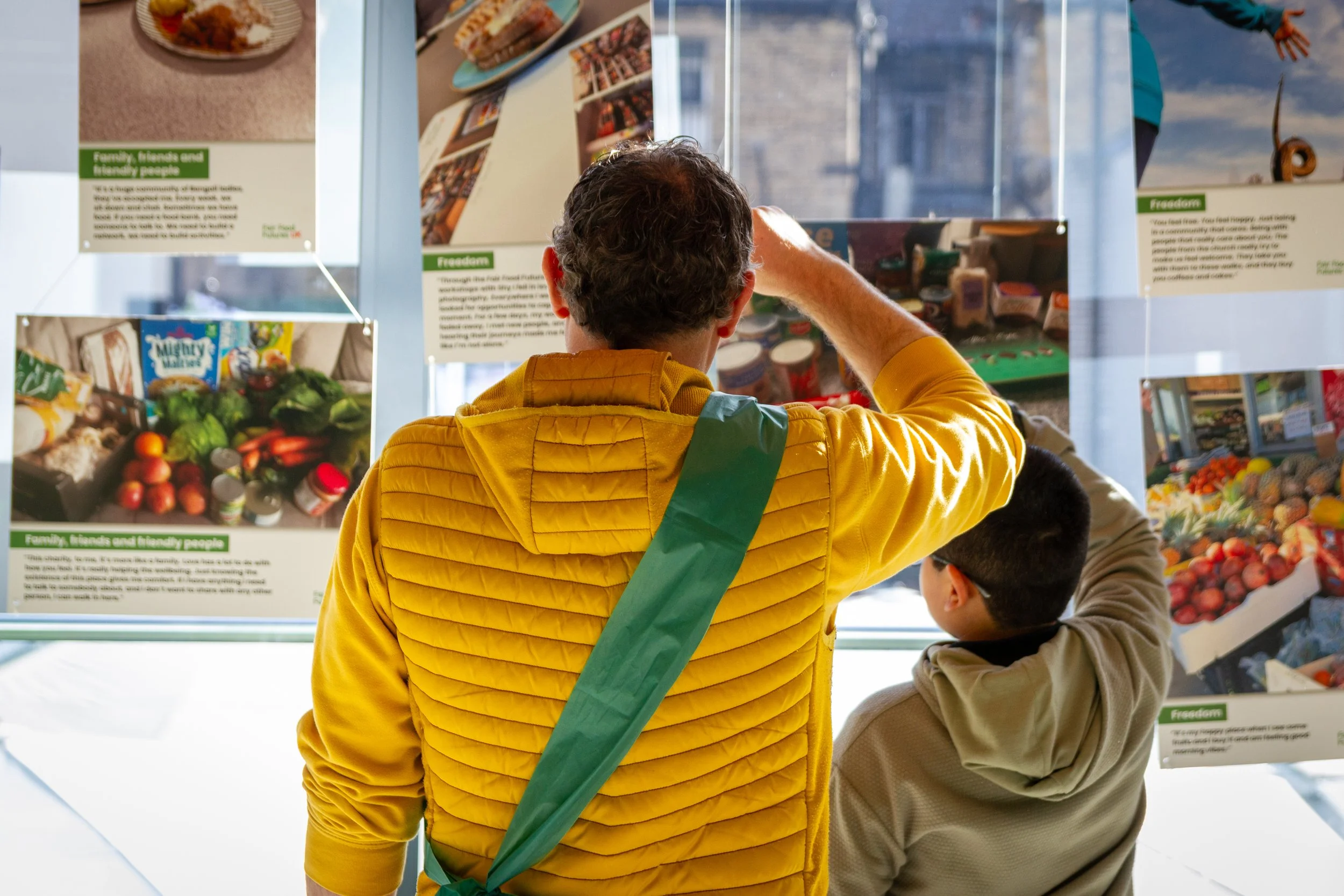
The Fair Food Futures UK exhibition brings together powerful photographs and stories of food help, dignity and belonging shared by families with children in Bradford and Tower Hamlets. The exhibition, co-curated by participants, researchers and a professional photographer, provides insights into the everyday realities of household food insecurity in the UK.

How did care play out in the different food aid spaces we observed in our ethnographic research?
Policy-related resources on the food aid sector in the UK
What does the new Crisis and Resilience Fund (CRF) guidance mean for food banks, food pantries, social supermarkets, food clubs, food partnerships, and food poverty alliances in English local authorities? Sustain. February 2026. Crisis and Resilience Fund FAQs for food partnerships and the charitable food sector. https://www.sustainweb.org/reports/feb26-crisis-and-resilience-fund-faqs-for-food-partnerships/
Trussell and Policy in Practice. December 2025. Resetting local crisis support in England. Recommendations for the new Crisis and Resilience Fund. https://www.trussell.org.uk/news-and-research/publications/report/resetting-local-crisis-support-in-england
IFAN et al. November 2025. The Crisis and Resilience Fund and charitable food provision. https://www.foodaidnetwork.org.uk/briefings/the-crisis-resilience-fund-and-charitable-food-provision
IFAN et al. August 2025. Cash first but not cash only. https://www.foodaidnetwork.org.uk/briefings/cash-first-but-not-cash-only
Food insecurity monitoring and reporting
Food Foundation Food insecurity Tracker. https://foodfoundation.org.uk/initiatives/food-insecurity-tracking
Department for Health and Environment and Rural Affairs, Food Security Report 2024. https://www.gov.uk/government/statistics/united-kingdom-food-
JRF. January 2026. UK Poverty Statistics 2026. Food Insecurity. https://www.jrf.org.uk/uk-poverty-statistics/food-insecurity
Social Market Foundation. June 2026. Growing up hungry: Measuring UK child food insecurity in 2026. https://www.smf.co.uk/publications/family-and-child-hunger-2026/

Academic papers based on this study findings
Mapping Local Community Food Organisation (pre-print)
Social innovation or ‘shops for poor people’? Building and contesting community food organisation actor-networks in the UK (under review)
‘Grab and Go’ versus ‘Wait and Hope’: how rationalisation of organisational practices in food charities affects families’ experiences of food insecurity in the UK. Social Policy and Society special issue on Food Charities (under review)
What approaches adopted by community food organisations are more likely to prevent the need for emergency food? BMJ Open (under review)
Download our list of resources


Read our key findings