Information for the public
In 2025, almost 1 in 5 families in the UK had issues with regularly accessing affordable and healthy food.
Many different organisations and initiatives have grown in recent years to try and alleviate food insecurity. Food banks typically provide emergency food parcels to support households with essentials for a few days; food pantries offer a wider selection of fresh food for a small fee, and many other food-related initiatives such, for example, community kitchens and community gardens. Some organisations have also started to provide wrap-around support services in addition to food, such as welfare advice and help with finding employment. Here we use ‘community food organisations’ to refer to both informal community projects and more established charitable food aid providers (food banks, pantries, social supermarkets, food clubs).
Fair Food Futures UK has been exploring ‘community food organisations’ (CFOs) in two cities in England: Bradford and London (Tower Hamlets).
Fair Food Futures UK has brought together researchers from University of York, University College London (UCL) and Bradford Institute for Health Research (BIHR) with people who have experienced food insecurity and staff from Bradford City and Tower Hamlets Councils.
What we did
We began in 2023 by mapping the community food organisations providing support with food and livelihoods in Bradford and Tower Hamlets.
Through a survey, workshops and interviews, we explored how community food organisations work, what they need to operate, relationships with each other and other services, the barriers they face and their dependencies on local and national policies.
After that, we explored how community food organisations affect families' lives. We observed that some organisations also provide other types of support beyond food, for instance, with benefits and bills.
Between 2024 and 2025, three researchers volunteered in nine community food organisations for a year to understand how they support families with young children.
We also recruited 40 families experiencing food insecurity to take part in the research. We met with each family up to three times over 14 months to talk about accessing food.
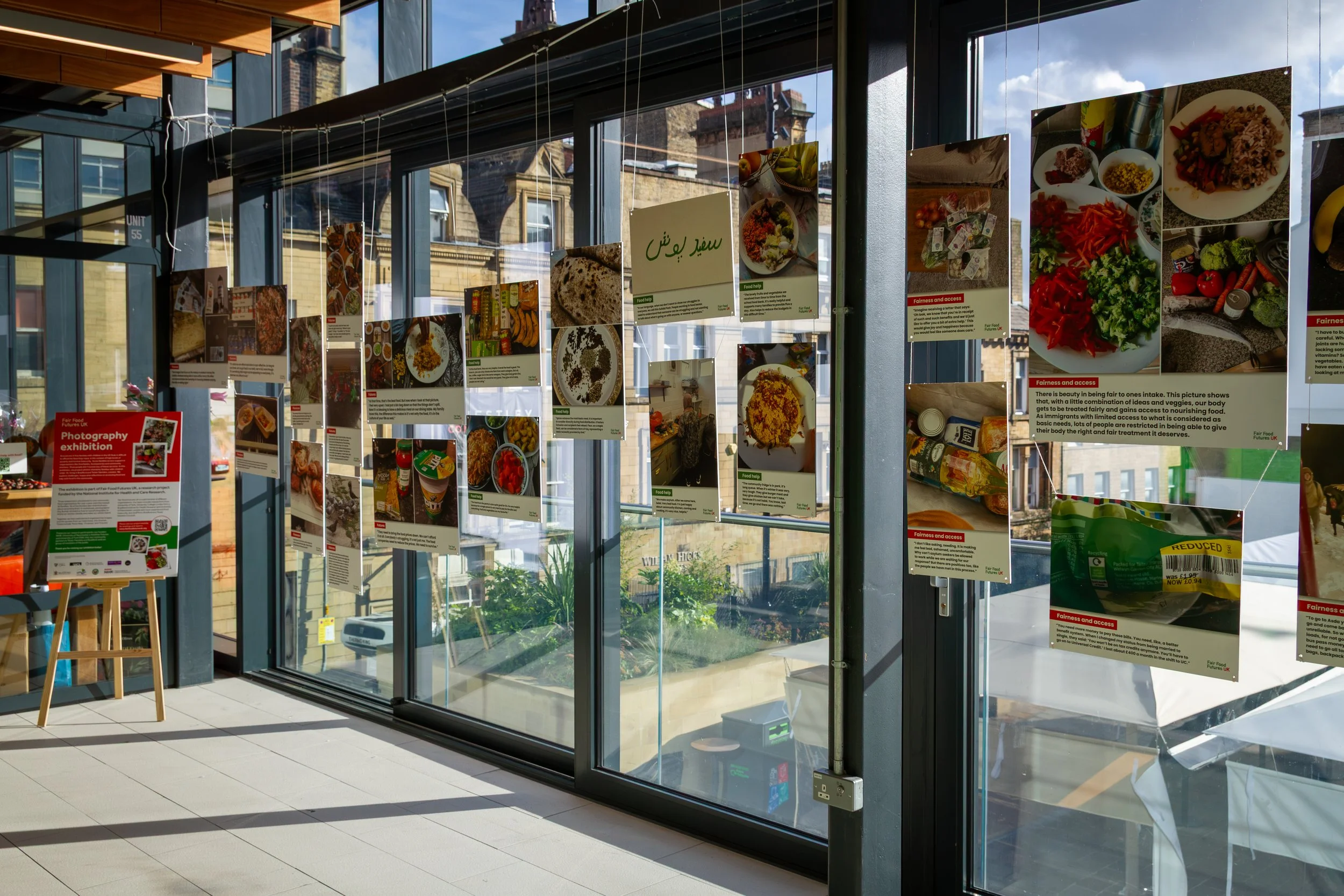
We invited parents to send us photos and videos about food in their everyday lives, and discussed these when we met.
Our findings will help governments to prioritise resources that really work for families and communities.
We have been sharing our findings with community food organisations, as well as with local and national governments, to help them improve support to families experiencing food insecurity. You can find a summary of our findings here. Working in partnership with our participants, members of our public involvement group, and professional photographer Shy Burhan, we created an exhibition of families’ photographs and quotes from interviews.
We launched it in Bradford and Tower Hamlets in October 2025. The exhibition is helping to raise awareness of how food insecurity impacts on families’ lives, what helps them, and the changes to policies and practices that families want to see. You can find more about this exhibition here.