Information for policy makers and researchers
In 2025, almost 1 in 5 families in the UK had issues with regularly accessing affordable and healthy food.
A wide range of organisations and initiatives have been providing food support to relieve household food insecurity, such as food banks, food pantries, community meals, cooking sessions, delivery of food packages, and meals for children during school holidays. Some organisations also provide support services to tackle underlying needs, such as welfare advice and support with finding employment.
Here we use ‘community food organisations’ as an inclusive term encompassing multiple, varied types of support and to refer to both informal community projects and more established charitable food aid providers (food banks, pantries, social supermarkets, food clubs).
Fair Food Futures UK has been exploring ‘community food organisations’ (CFOs) in two cities in England: Bradford and London (Tower Hamlets).
Fair Food Futures UK has brought together researchers from University of York, University College London (UCL) and Bradford Institute for Health Research (BIHR) with people who have experienced food insecurity and staff from Bradford City and Tower Hamlets Councils.
What we did
We began in 2023 by mapping CFOs (e.g. food banks, pantries, community cafes) providing support with food and livelihoods in Bradford and Tower Hamlets. Through a survey, workshops and interviews, we explored how CFOs work, what they need to operate, relationships with each other and other services, the barriers they face and their dependency on local and national policies.Through a survey, workshops and interviews, we explored how CFOs work, what they need to operate, relationships with each other and other services, the barriers they face and their dependency on local and national policies.Our findings from the systems mapping are presented here, with a focus on the local level, and here with a focus on the national level. We have also produced an interactive typology-map to illustrate the diversity and complexity of the CFO sector in the UK, in terms of models, activities and connections. We then explored how CFOs affect families' lives. We observed CFOs varied in the types of support they provide: some focus on food, while others also provide support ‘beyond food’, for instance benefits advice or help with energy bills. We wanted to understand if any particular way of operating, or a combination of food and additional services, was more successful in helping families to no longer need food support.
Between 2024 and 2025, three researchers volunteered regularly in nine community food organisations for a year to understand how they support families with young children. We also recruited 40 families experiencing food insecurity to take part in the research.
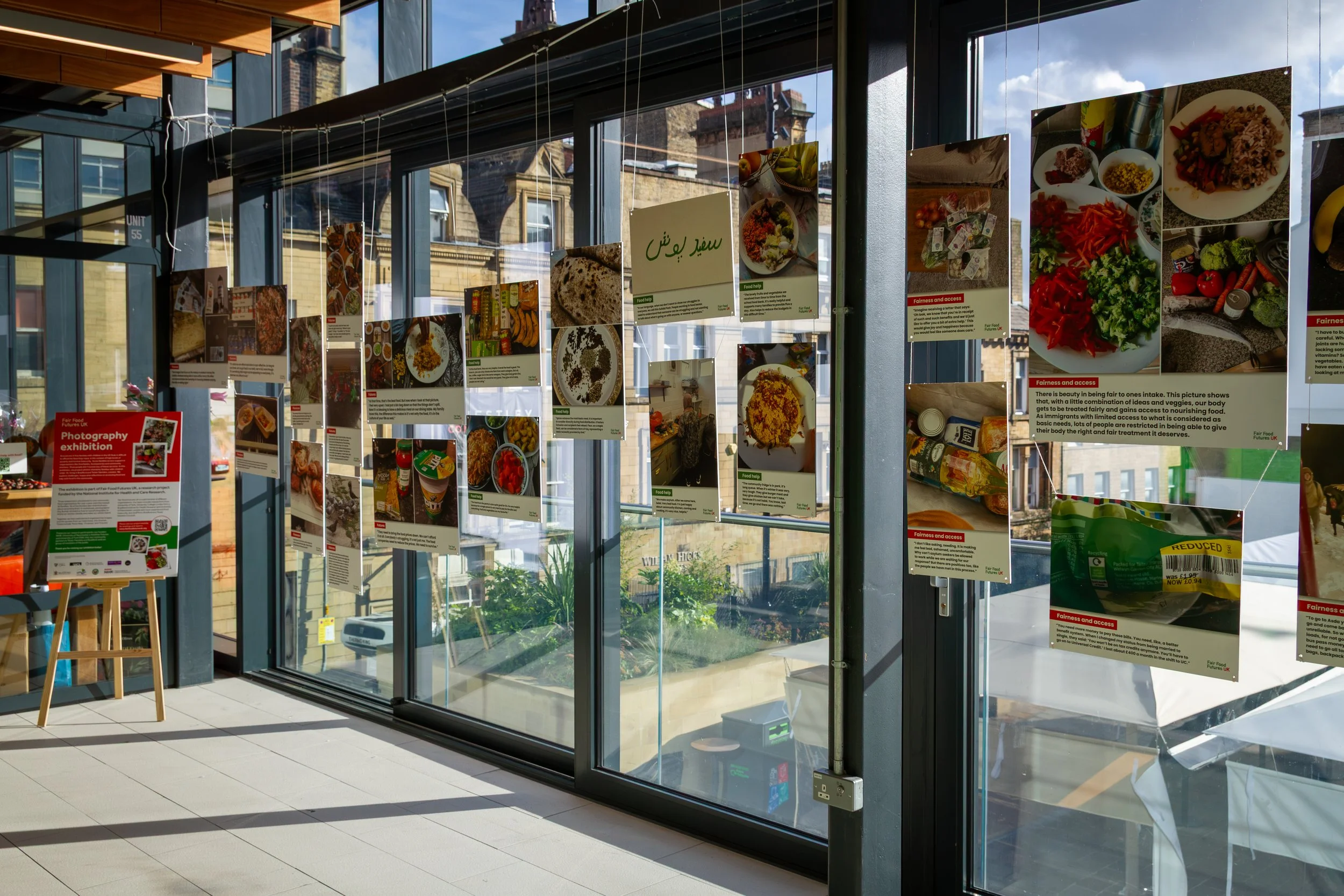
We met with each family up to three times over 14 months to talk about accessing food. We invited them to send us photos and videos about food in their everyday lives, and discussed these when we met.
Working in partnership with our participants, members of our public involvement group, and professional photographer Shy Burhan, we created an exhibition of families’ photographs and quotes from interviews.
The exhibition is helping to raise awareness of how food insecurity impacts on families’ lives, what helps them, and the changes to policies and practices that families want to see.
It has been based at Bromley by Bow Community Centre, Tower Hamlets Town Hall (Whitechapel), Darley Street Market in Bradford, and it is now at UCL Social Research Institute and at the Universally Manchester Festival 2026.
What we found
The food support sector is large, complex and diverse
CFOs differ in how they deliver support and manage access, how they work in partnership and how they access resources.
It is a sector facing multiple challenges
CFOs rely on medium/short-term government funding, volunteers and surplus food. Many are also constrained by time, space and specialist skills (e.g. access to advice). We found that it is not only the CFO ‘model’ or types of services offered that make a difference. What also matters is the use of the space and the amount of time people can spend there when they access support services. These factors shape the kinds of interactions that take place between staff, volunteers and families. They influence how families feel when they access the space, whether they feel able to disclose their needs, and how supported they feel, both practically and emotionally, and what happens next.
There is a variety of approaches to address household food insecurity
Almost all CFOs provided free or low cost food to alleviate food insecurity (tertiary prevention). Some provided additional support such as advice services to address underlying issues (secondary prevention). A minority sought to address long term issues, e.g offering employability support or campaigning to change national or local policy (primary prevention).
We have been sharing our findings with community food organisations, as well as with local and national governments, to help them improve support to families experiencing food insecurity. A summary of our key findings, our policy briefs and additional resources are available here.
Contact
If you would like to discuss the research with us, please contact Prof Maria Bryant (maria.bryant@york.ac.uk).